
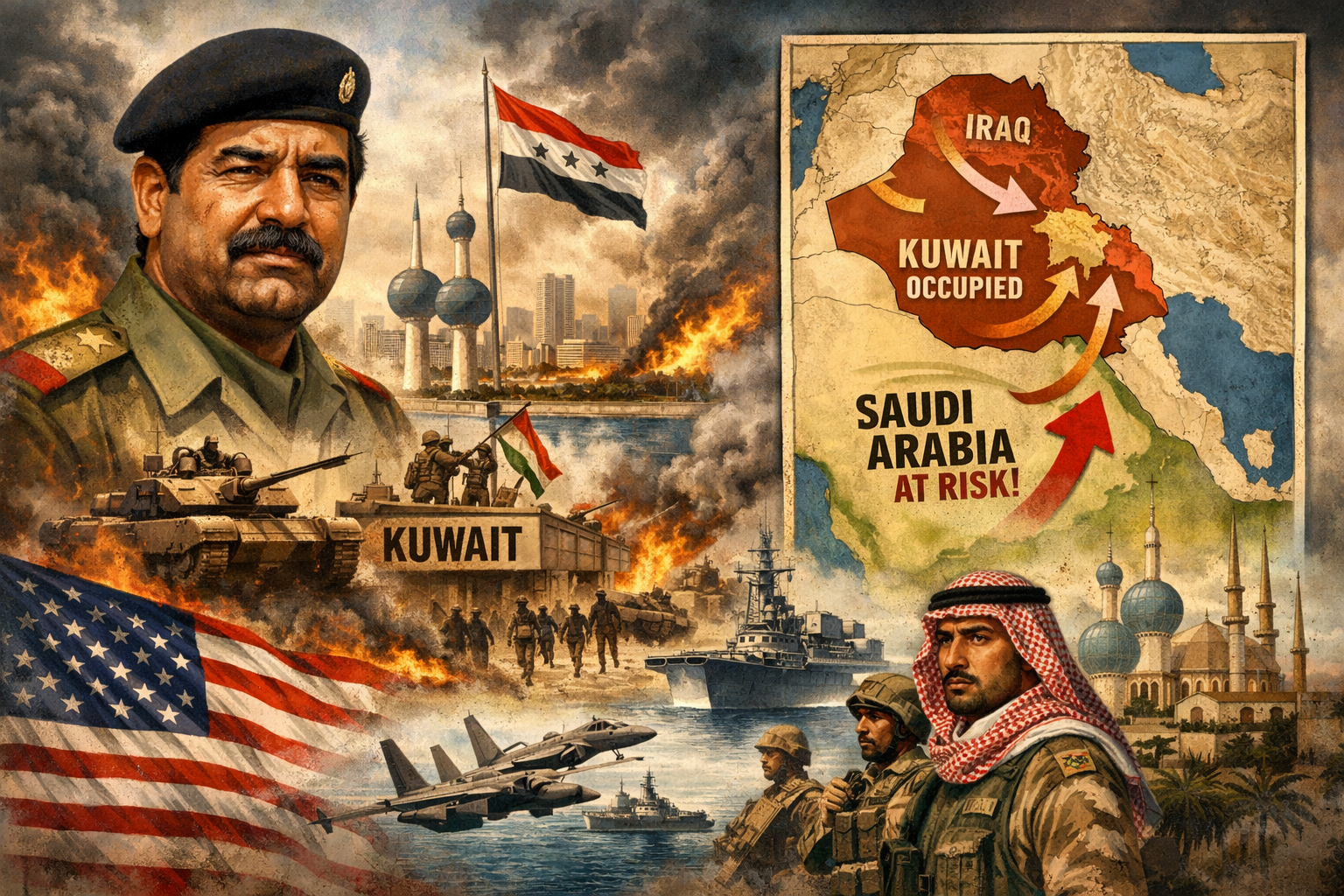
Throughout history, the United States has used its military power at critical moments to defend freedom, uphold international law, and protect its allies. One of the clearest examples of this role occurred during the Gulf War of 1991, also known as Operation Desert Storm or the Liberation of Kuwait. This conflict demonstrated how American military strength, when used for a just cause, could restore sovereignty, deter aggression, and rally the world against tyranny.
The Invasion That Crossed the Line
On August 2, 1990, Iraq, under the dictatorship of Saddam Hussein, invaded and occupied Kuwait. The invasion was justified by Iraq using accusations of illegal oil drilling along the border—claims widely viewed as a pretext for territorial expansion. For years prior, Saddam Hussein had tested the resolve of the international community through aggressive and barbaric actions. The invasion of Kuwait marked a turning point that could no longer be ignored.
This was not simply a regional dispute. Kuwait was an ally of the United States, and the occupation threatened the stability of the entire Middle East. More importantly, it placed Saudi Arabia—another key U.S. ally—at serious risk of becoming the next target.
Exhausting Peaceful Options First
The United States and its allies did not rush into war. Diplomatic efforts and negotiations were pursued in an attempt to resolve the crisis peacefully. However, Saddam Hussein openly defied the international community and continued plans to absorb Kuwait, signaling his willingness to expand further into neighboring nations. When diplomacy failed, military action became unavoidable.
A Global Coalition Against Aggression
One of the most significant aspects of the Gulf War was the unprecedented international coalition formed to confront Iraq’s aggression. A total of 34 nations contributed troops, ships, weapons, and logistical support. This coalition demonstrated that America was not acting alone, but as a leader of a united front committed to defending international law and sovereignty.
The message was unmistakable: when a nation becomes an ally of the United States, that alliance carries real weight and real consequences for aggressors.

The Power of Modern Warfare
The military campaign began on January 17, 1991, with a massive and highly coordinated air assault. The intensity and precision of the bombing campaign stunned Iraqi forces and crippled their ability to respond effectively. This overwhelming show of force made it clear that Iraq’s military could not withstand the coalition’s technological and strategic superiority.
What followed was one of the most brilliant ground campaigns in modern military history. Iraqi commanders believed the vast desert behind their forces made them invulnerable to a rear attack. This assumption proved disastrous. Coalition forces used advanced satellite navigation and night maneuvers to cross the desert and strike the Iraqi Republican Guard from an unexpected direction, delivering a decisive blow.

A Lightning Victory
The speed of the campaign was remarkable. In less than 90 days, Iraqi forces were defeated, and Kuwait was fully liberated. By early March 1991, major combat operations had ended. The conflict demonstrated not only the effectiveness of the American-led coalition but also the strategic restraint exercised once the mission was accomplished.
Leadership and Restraint
After the liberation of Kuwait, debates emerged about whether the coalition should have continued on to overthrow Saddam Hussein’s regime. President George H. W. Bush chose instead to adhere strictly to the original mission—restoring Kuwait’s sovereignty. This decision reflected disciplined leadership and respect for international objectives, contributing to Operation Desert Storm being remembered as one of the most successful military campaigns in U.S. history.
A Lasting Lesson
The liberation of Kuwait sent a powerful message to the world: aggression against sovereign nations would not be tolerated, and the United States would stand by its allies when it mattered most. It reinforced America’s role as a global leader capable of combining military strength, international cooperation, and strategic restraint to achieve justice on the world stage.