
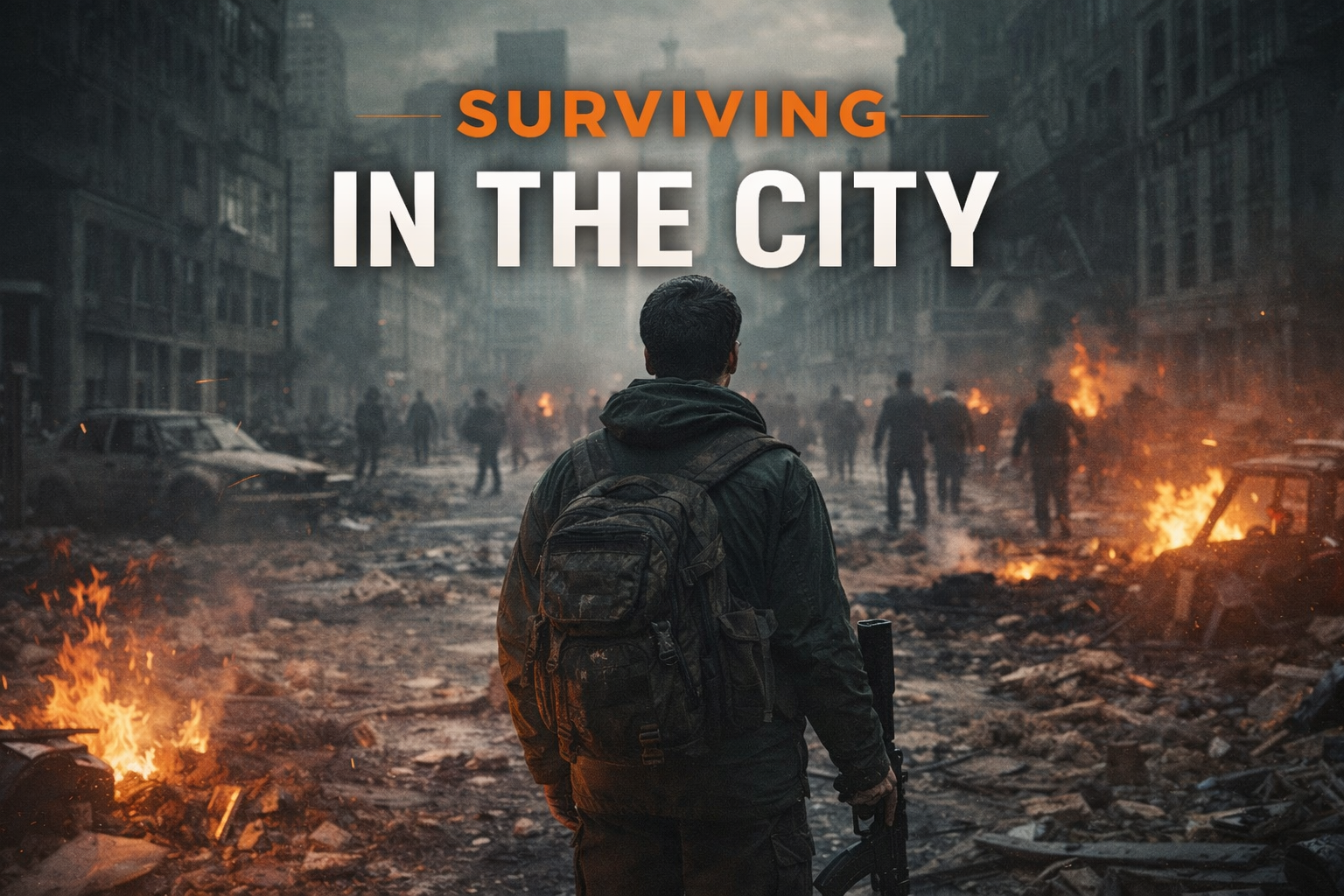
When people talk about preparedness, they often imagine escaping to the countryside. The reality is far different. Most Americans will still be in cities when a serious crisis hits—whether because of jobs, family, finances, or simple logistics. If you’re one of them, urban survival requires a very different mindset than rural preparedness.
Cities are efficient, convenient, and densely populated—but they are also fragile. When critical systems fail, cities unravel faster than almost any other environment.
Why Cities Are Inherently Vulnerable
Cities are artificial systems. They do not produce their own food, and they rely on uninterrupted transportation, power, and water infrastructure to survive. Modern “just-in-time” delivery systems mean grocery stores often carry only a few days’ worth of food. If shipments stop, shelves empty almost immediately.
No city can feed itself. That single fact defines urban survival risk more than anything else.

The Four Major Urban Survival Threats
1. Collapse of Social Order
Social order is largely psychological. When people believe police, emergency services, and government are functioning, behavior remains mostly lawful. Once that belief disappears, order can collapse rapidly.
History has shown that riots, looting, and violence erupt when food, water, or money becomes scarce. When emergency services are overwhelmed or absent, some individuals revert to predatory behavior. This breakdown can happen even before infrastructure fully collapses.

2. Failure of Water Systems
Water is the fastest killer in an urban crisis. People can survive weeks without food—but only days without water.
Most city water systems depend on electricity, automation, chemicals, and skilled labor. If any part of that chain fails, water may stop flowing or become unsafe to drink. Once taps run dry, panic escalates quickly. Stores are looted for bottled water, and desperate people search homes and neighborhoods for remaining supplies.

3. Food Supply Depletion
Urban food shortages escalate rapidly. As soon as delivery delays begin, panic buying accelerates depletion. Within days, grocery stores are empty.
Once food is gone, people leave the city if they can—or they begin taking it from others. This stage is often when violence becomes unavoidable in high-density areas.

4. Power Grid Failure
Power failure has the largest psychological and practical impact. Without electricity, everything else follows: water systems shut down, communications fail, heating and cooling stop, hospitals strain, and law enforcement loses coordination.
In extreme temperatures, loss of power can be fatal in days or even hours. Power failure often acts as the trigger that pushes cities from inconvenience into chaos.

Stay or Go? Two Urban Survival Strategies
If you’re in a city during a crisis, you realistically have two options:
Option 1: Stay and Defend
Staying put may be the safest option if:
You have food and water stored Your neighborhood is stable You can limit visibility and attention You have cooperative neighbors
Urban survival improves dramatically when neighbors work together. Shared defense, shared information, and shared resources discourage opportunistic threats and reduce panic.
Option 2: Bug Out
Leaving the city carries serious risks:
Fuel shortages and traffic gridlock Roadblocks and violence Mechanical failure Limited carrying capacity Uncertainty about destination safety
Bugging out without a specific, prepared destination is often more dangerous than staying. Leaving should be a deliberate decision—not a panic reaction.
Food and Water: Store It—and Hide It
In cities, concealment matters as much as storage. Visible supplies attract attention. Once known, they may be taken by force.
Effective strategies include:
Distributing food storage throughout the home Concealing supplies within walls or structural spaces Burying long-term food in sealed containers (where possible) Maintaining decoy supplies to discourage escalation
Water storage is equally critical. A minimum of two gallons per person per day is recommended for long-term planning, along with filtration or purification capability if supplies run out.
Defense, Visibility, and Discipline
Urban survival favors those who avoid attention. Light, noise, smells, and movement can draw unwanted visitors.
Key principles:
Minimize nighttime lighting Black out windows Control noise Maintain perimeter awareness Practice emergency drills with family members
Defence tools and strategies vary by location and law, but early warning, deterrence, and cooperation with neighbors are often more effective than isolation.
The Power of Community
Your neighbors may determine whether you survive. A prepared neighborhood is safer than a well-stocked house surrounded by desperate people.
Helping others prepare reduces your long-term risk. Every self-reliant neighbor is one less threat when systems fail.
Final Thoughts: Urban Survival Is About Realism
Staying in the city is not foolish—but it requires preparation, discretion, and cooperation. The closer you are to population centers, the faster problems escalate when systems fail.
The best survival advantage is not panic or gear—it is planning before crisis arrives.
Because once the city starts to unravel, there are no easy choices—only prepared ones.